How to Run a Trial Mental Arithmetic Lesson: From the Abacus to the First Mental Calculation
A trial mental arithmetic lesson should not be just a demonstration of fast calculation. And it should not feel like an ordinary mathematics class. The most important goal is for both the parent and the child to understand:
- what mental arithmetic is;
- why the abacus is used;
- how the learning process begins;
- and where this training can eventually lead.
For the child, there is one more important goal: to experience a real first success during the very first lesson. Not simply watch the teacher calculate. But actually: try it themselves.
A good trial abacus lesson should help parents understand the purpose of mental arithmetic while giving the child a real first success. Introduce the physical abacus, teach correct finger movements, practise simple +1 and +2 operations, and, when possible, let the child try a first simple mental-abacus exercise.
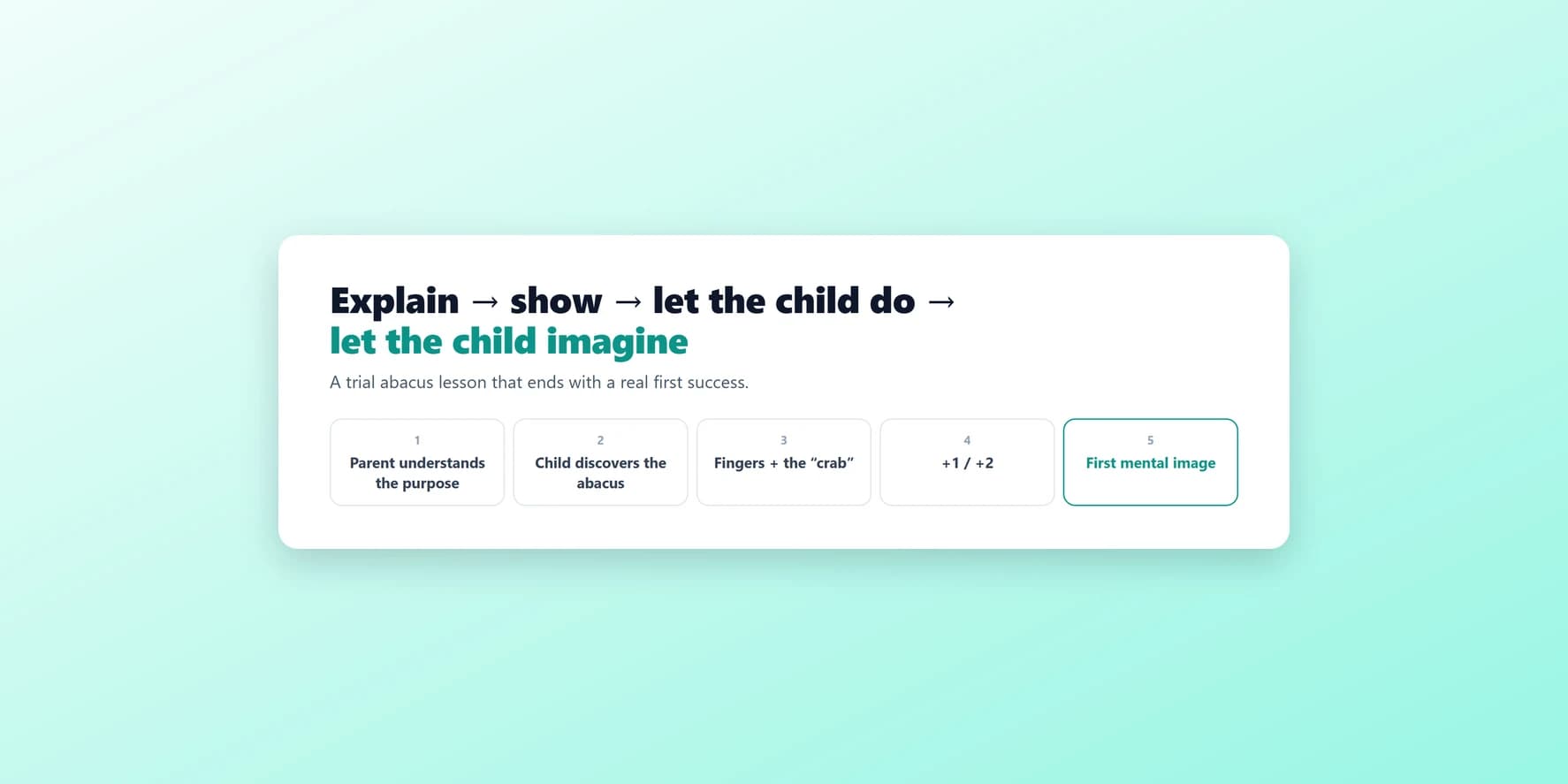
- Parent understands the purpose
- Child discovers the abacus
- Correct fingers + the “crab”
- +1 / +2
- First independent examples
- Advanced student video
- First mental image
- Home practice
The first abacus lesson — a ready reminder for the teacher.
Start by explaining mental arithmetic to the parent
This is an important first step. Many parents arrive with one expectation:
“My child will learn to calculate very quickly.”
Fast calculation is certainly one of the most visible outcomes. But it is not the only purpose of the programme. Mental arithmetic is better understood as developmental cognitive training built around the abacus and mental visualisation. The child practises:
- concentration;
- working with visual images;
- holding and processing information;
- switching between operations;
- following sequences;
- building automatic skills through repetition.
Fast calculation becomes one of the clearest visible results of this training — we describe the wider picture in what mental arithmetic develops.
That distinction is important. Parents should understand from the beginning: this is not simply another mathematics programme. And its goal is not only to make a child add numbers faster.
Fast calculation is a visible result — not the only purpose of mental arithmetic.
Fast calculation is a visible result, not the only goal
Speed is easy for parents to notice. Over time, children may begin to calculate faster, with more complex numbers and eventually without using the physical abacus for every operation. That can be impressive.
But the learning process begins much earlier. First, the child learns physical movements on the abacus. Then those movements become more automatic. Gradually, the child develops a visual representation of the abacus. And more calculation can begin to move into mental imagery.
That is the learning journey parents should understand.
Keep the explanation short — then involve the child
The parent introduction should not take half the trial lesson. After the main idea is clear, the child should become the centre of the session.
The first tool is the physical abacus. Do not begin with a long theoretical explanation. It is usually better to show it, let the child touch it, demonstrate the movement and ask the child to copy it.
Introduce the physical abacus
Show the child how the abacus is structured, where the beads are, where the beam is, how numbers are represented and which fingers will be used.
For the child, this is a completely new object. The first lesson should feel like discovery. Not an examination.
Correct finger technique starts on the first lesson
It is important not to allow the child to move the beads in any convenient way. Correct habits should begin immediately. For the lower beads:
- the thumb moves beads upward toward the beam;
- the index finger moves them downward away from the beam.
The movements should be short, clear and controlled. At first, this may feel like a small game. But the foundation of future technique is already being created.
Use child-friendly images
Technical explanations do not always work well with young children. Simple visual associations often work better. One useful example is the “crab.” The child sees two fingers, a coordinated movement — a small “crab.” It is memorable and often makes children smile.
These small playful associations can turn a technical movement into something easy to understand, fun and easy to remember.
Even pencil technique matters
This may appear to be a minor detail. But during workbook practice, the child needs to calculate, write the answer, return to the abacus, calculate again, write again.
If the child holds the pencil awkwardly and writes every answer very slowly, this can affect the rhythm of the whole exercise. So even during an introductory lesson, it can be useful to show a comfortable pencil grip, how to write an answer efficiently and how to move naturally between the abacus and the workbook.
The goal is not perfect handwriting. The goal is efficient practice.
Do not explain for too long — let the child calculate
After introducing the abacus and finger technique, move quickly to the most important moment: the child should produce their first result.
Begin with very simple operations. For example: +1, +2. Show the movement. Let the child repeat it. Very quickly, the child can begin solving the first simple examples independently.
The first success should happen during the first lesson
This matters. The child has entered an unfamiliar environment. There is a new teacher, a new tool, a new learning system. And within a short period of time, the child can already feel:
“I can do this.”
The skill may be very small. But it is real.
One real skill is better than ten minutes of promises
A teacher can spend a long time telling the parent how fast the child may calculate in the future, how complex the exercises will become, how competitions work and what advanced mental calculation looks like.
But something much more convincing can happen during the lesson. The parent sees: ten minutes ago the child had never used an abacus; now the child is already completing the first operations independently. That is much more tangible.
One real first skill is more convincing than ten minutes of promises.
Show where the learning can lead
Once the child has experienced the first basic movements, it can be useful to show a short video of more advanced students. This gives both the child and the parent a picture of the future.
But it is important to frame the video correctly. Not:
“This is what your child will do next month.”
But:
“This is the kind of level children can gradually reach through regular practice.”
Today: simple physical movements. Later: more rules; greater speed; mixed practice; mental calculation. The video shows the direction of development.
A video should inspire, not create unrealistic expectations
A highly advanced Anzan demonstration can be impressive. But without explanation, it may also create a false expectation that every child will immediately calculate at that level.
The teacher should make the progression clear. Advanced speed is the result of learning, repetition, technical development and regular practice. It is not the starting point.
Under such a video: “An example of a more advanced level reached through regular training — not an expected result of the first lesson.”
Then try the most interesting step: mental calculation
In our approach, the idea of mental calculation does not need to remain hidden until much later. Once the child understands very simple physical operations such as +1 and +2, the teacher can introduce a small experiment.
Ask the child to imagine the abacus
For example:
- show the number physically;
- perform the movement;
- then ask the child to imagine the same abacus;
- and try to reproduce the simple operation mentally.
The exercise should remain extremely easy. This is not advanced Anzan. It is the child's first introduction to: mental imagery.
The first mental calculation does not need to be difficult. It only needs to show the principle.
It will not work immediately for every child — and that is fine
One child may immediately say “Yes, I can see it.” Another may find it difficult. Another may move their fingers in the air while trying to imagine the beads. All of these reactions can be normal.
The trial lesson is not testing “Is this child capable of mental arithmetic?” The teacher is introducing the principle — whether mental arithmetic suits a particular child becomes clear over time, not in one session.
If the first mental calculation works, it can be a powerful moment
The child has just seen an abacus for the first time, learned the first movements, performed simple operations — and then managed to reproduce a simple action mentally. For the child, this can feel like a discovery:
“I can calculate using an abacus in my head.”
For the parent, the progression becomes immediately understandable. They can see why the physical abacus is used and what the skill can gradually become.
Explain physical and mental practice as one connected process
Parents should not leave with the impression that the programme consists of two unrelated stages: first, years of moving physical beads; then suddenly mental calculation. A better explanation is:
- the physical abacus creates the foundation;
- mental representation begins gradually;
- the two can develop in parallel;
- as skills become stable, more calculation can move into imagination.
At first, the mental element may be very small. That is completely normal — see physical vs mental abacus.
You do not need complex topics to demonstrate the principle
For a trial lesson, very simple operations are enough. The purpose is not to demonstrate complexity. The purpose is to demonstrate the transition:
- See the abacus
- Move the beads
- Repeat the movement
- Remember the position
- Imagine the abacus
Mental calculation begins with a physical visual model.
This is the core idea.
A trial lesson should feel alive
For a young child, this format is usually weak: 15 minutes of talking; 15 minutes of explanation; 15 minutes of theory; 15 minutes of homework instructions.
A better rhythm is: listen; touch; try; smile; watch; calculate. Short changes of activity help maintain interest.
Playful associations are particularly useful
The crab. Finger movements. Trying to improve the second attempt. Recognising a number. Imagining the abacus. These small elements help the lesson feel less like another school subject.
The child should leave thinking: “That was interesting.”
Do not try to teach too many topics
For a first trial lesson, it can be completely sufficient to:
- introduce the abacus;
- show correct finger technique;
- learn +1 and +2;
- solve several examples;
- try a simple mental calculation;
- show what future training can look like.
That is enough. The important question is not “How much curriculum did we cover?” It is:
“Did the child understand the principle and want to continue?”
The parent watches the method in action
This is far more powerful than a long presentation. The parent can see how the teacher explains, how the child reacts, how quickly the child understands, where correction is needed and how the result changes.
The parent does not have to rely only on promises about the methodology. They see the methodology working.
Before the lesson
Never used an abacus
After the lesson
Knows basic finger movement · understands +1 / +2 · can solve first examples · has tried mental visualisation
What the parent sees in one trial lesson: a small but real result.
Summarise the lesson in concrete terms
At the end, the teacher can say something simple such as:
“Today your child learned how the abacus works, practised the correct finger movements, completed the first +1 and +2 operations, and tried to imagine a simple movement mentally.”
This is clear. The parent knows exactly what happened.
Explain the learning path briefly
Then show what will gradually come next: new operations; Small Friends; Big Friends; larger numbers; greater speed; mixed practice; mental calculation.
There is no need to explain the entire curriculum. The parent only needs to understand the direction.
Explain the importance of regular practice
Mental arithmetic develops through repetition. One lesson per week without practice between lessons usually produces much less progress.
But regularity does not necessarily mean 40 minutes of difficult homework every day. For a beginner, shorter and consistent practice is often more realistic. The key idea is: regular practice — see how often children should practise.
This is a natural moment to show the application
Do not turn this into a software demonstration. Connect it directly to what the child has just learned. For example:
“Today we learned +1 and +2. At home, the child can practise exactly these skills in the application.”
Now the platform has a clear purpose.
Digital practice should continue the lesson
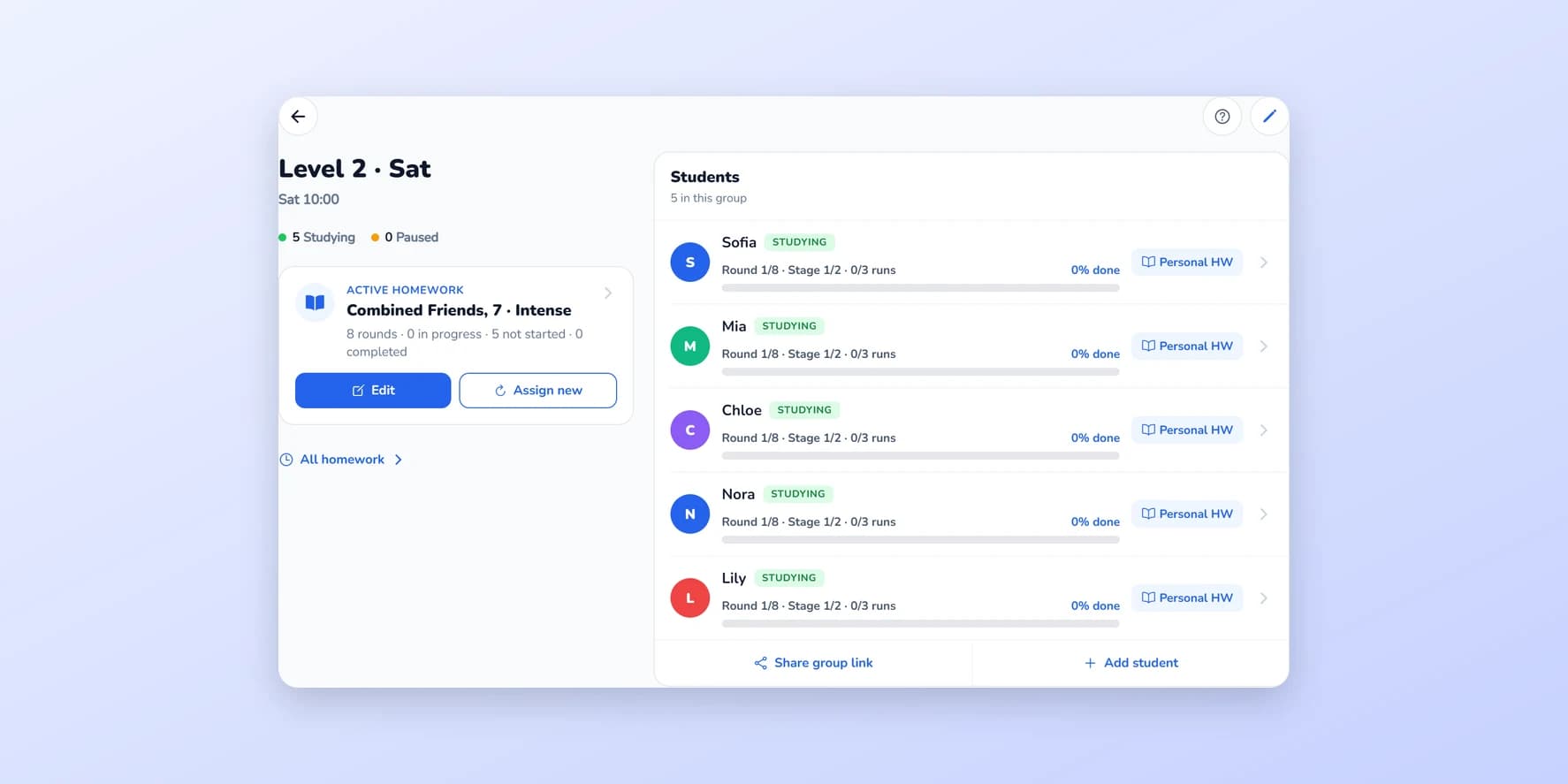
The teacher can control the topic, difficulty, speed and practice volume. The child does not need to decide “What am I supposed to practise today?” The assignment is clear.
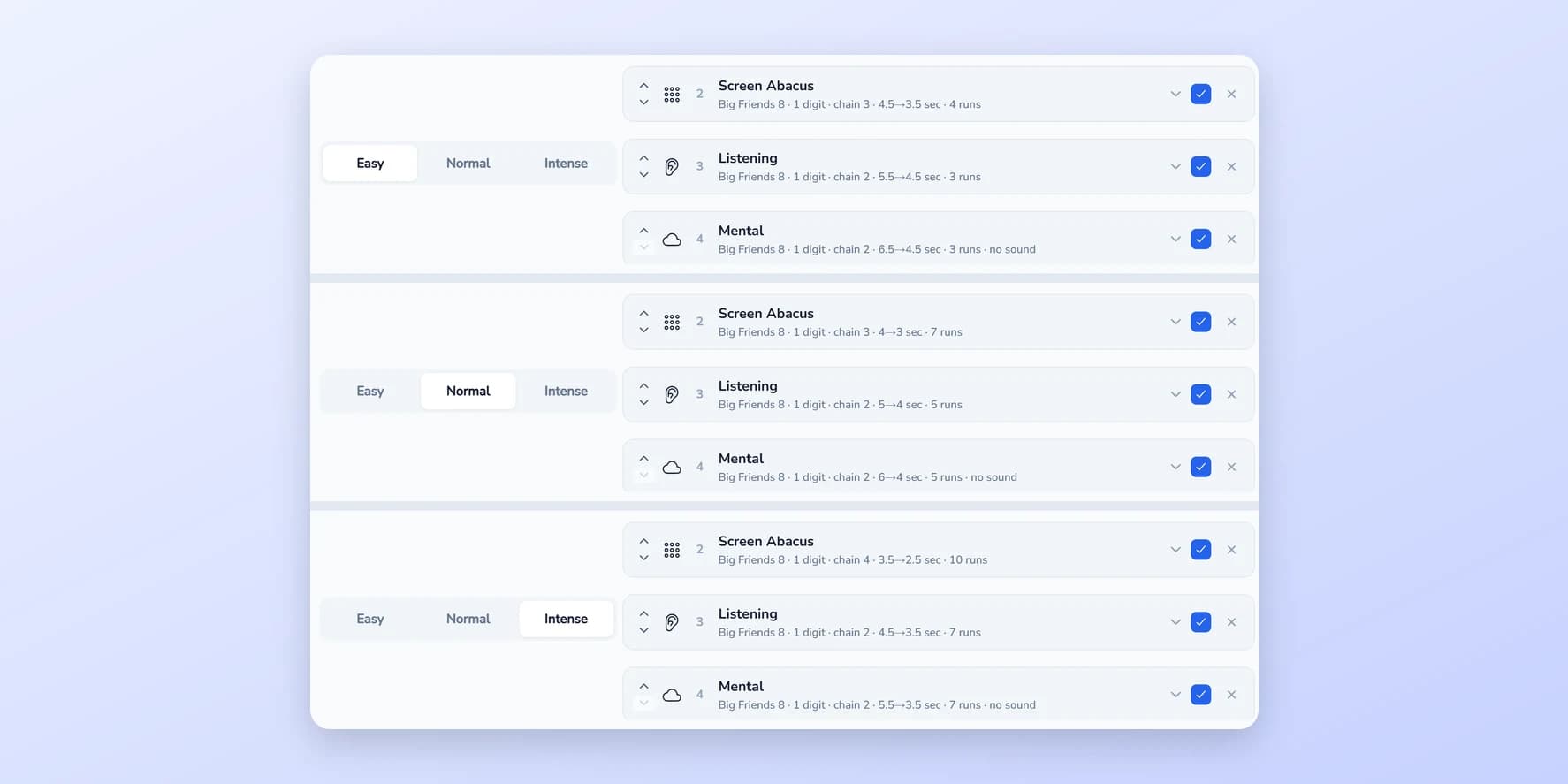
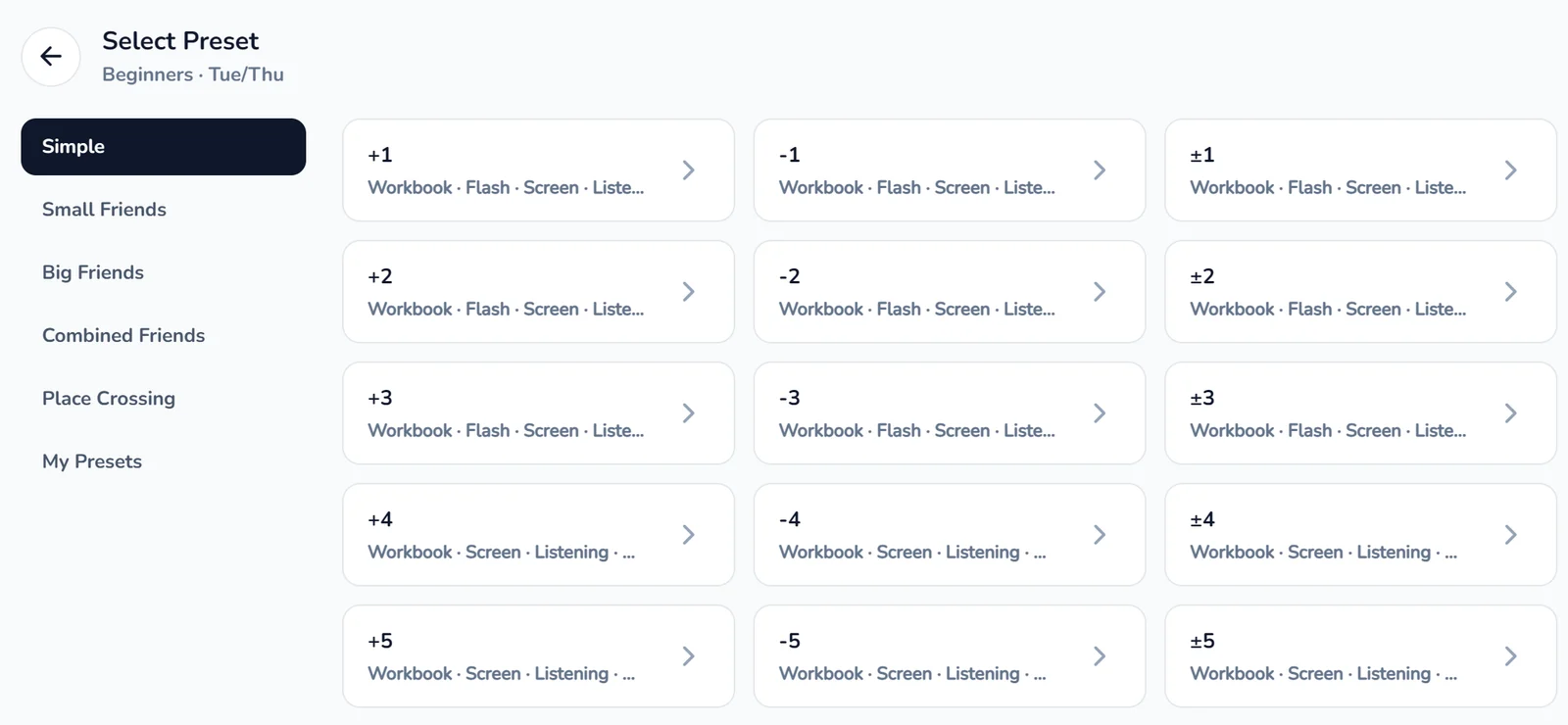
In Amavit, the teacher starts homework from the same topic the child has just met — in the Simple category there are ready presets for +1, +2 and the other first operations — and can then adjust the speed, number of rounds and difficulty.
Parents need to understand why the platform exists
Not simply because “We have an app.” The platform helps teachers support regular practice, provide enough repetition, adjust speed, see results and gradually increase difficulty. It extends the learning process between lessons.
The application should continue the lesson — not replace it.
The workbook still matters
Digital practice does not replace everything else. The child can still work with the physical abacus, a workbook, written answers and a pencil. Each format supports a different part of the learning process — see why mental arithmetic needs more than one type of practice.
The best system does not need to choose workbook or application. They can complement each other. Homework itself can then live in one place — see moving abacus homework beyond WhatsApp.
Do not promise the same result for every child
One child may successfully try mental calculation during the first lesson. Another may need more time. One may remember the finger movements immediately. Another may need repeated demonstrations. That is normal.
Learning speed depends on age, regularity, individual development and practice volume. A trial lesson should show the process, not promise an identical timeline.
Every child should still leave with a sense of achievement
Even if the mental exercise does not work immediately. The child has already discovered a new tool, learned a correct movement and solved the first examples. That is a genuine first result.
A practical trial-lesson structure
| 1. Brief parent explanation | Mental arithmetic is a developmental training programme; fast calculation is one of its visible outcomes. |
|---|---|
| 2. Introduce the abacus | Show how it works. |
| 3. Correct finger technique | Thumb and index finger. Use child-friendly images such as the “crab.” |
| 4. Pencil technique | Show how to record answers quickly and comfortably. |
| 5. First operations | +1. +2. Several independent examples. |
| 6. Show an advanced example | A short video of what children can gradually achieve. |
| 7. First mental experiment | Imagine the abacus and try a very simple mental operation. |
| 8. Summarise for the parent | What the child achieved and how learning will develop. |
| 9. Show how practice continues | Physical abacus + workbook + digital practice. |
That is enough for the first lesson.
Why this structure works
The parent receives a clear understanding of the purpose. The child receives a real first skill. The teacher receives a first impression of how the child learns. And the family receives a clear picture of what happens next.
A trial lesson is not an examination
The child does not need to prove anything. They are there to discover the method. The teacher's role is to show, explain, let the child try and create the first successful experience.
If the child has already studied mental arithmetic elsewhere, the first meeting has a different goal — finding the right starting point; see how to assess a new abacus student.
And it should not become a sales presentation
A well-run trial lesson demonstrates value naturally. The parent sees that the child is involved, the method has structure, the child achieves something during the lesson and the next steps are clear.
That is usually much more convincing than a long sales speech.
The main conclusion
A strong trial mental arithmetic lesson can follow a very simple logic:
explain → show → let the child do → let the child imagine.
First, explain to the parent: mental arithmetic is not simply a fast-calculation course. Then show the child the physical abacus, correct finger technique and the first simple operations. Then let the child calculate independently. And, when possible, let the child take the first small step from the physical abacus toward mental imagery during the same lesson.
It will not work immediately for every child. That is not a problem. The most important result is that the child leaves thinking:
“I can already do something — and I want to see what comes next.”
And the parent leaves understanding:
“Now I can see how this system works and why my child is learning it.”
For a first lesson, that is more than enough.
Frequently asked questions
What should happen in a first abacus trial lesson?
The child can learn how the abacus works, practise correct finger movements, complete simple +1 and +2 operations and, when appropriate, try a first basic mental-abacus exercise.
Should parents be told that mental arithmetic is mainly about fast calculation?
Fast calculation is one visible outcome, but the programme also involves concentration, visualisation, sequential processing and repeated skill practice.
Can a child try mental calculation during the first lesson?
Yes. A very simple mental-abacus exercise can be introduced after the child understands the first physical movements. Not every child will succeed immediately, and that is normal.
What is the “crab” in abacus teaching?
It is a child-friendly visual association used to make coordinated finger movements easier to understand and remember.
Why teach pencil technique in an abacus lesson?
Efficient writing helps the child move quickly between calculation and recording answers during workbook practice.
Should the teacher show advanced mental calculation during a trial class?
It can be useful as a demonstration of the future learning path, provided it is clearly presented as an advanced result rather than an immediate expectation.
Should a trial lesson include the app?
Yes, but only briefly and in context. The application should show how the same skill learned during the lesson can be practised between lessons.
How much should a child learn in a trial lesson?
A small, genuine first skill is enough. The goal is understanding and engagement, not covering a large part of the curriculum.
Free for teachers