Online or Offline Mental Arithmetic: Which Is Better for a Child?
A few years ago, mental arithmetic was taught mainly offline. A child would go to a learning centre, sit at a desk and use a physical abacus, a workbook and flashcards. The teacher was physically present and could observe every movement closely.
Today, families have more options. Mental arithmetic can be learned:
- in a physical centre;
- online with a teacher;
- in a small online group;
- one-to-one by video;
- or through a combination of online and offline learning.
So parents naturally ask:
“Which is better?”
The answer is not simple. Offline learning has important strengths. Online learning has different strengths. And in many cases, the quality of the teacher and the structure of the program matter more than whether the teacher is physically in the same room.
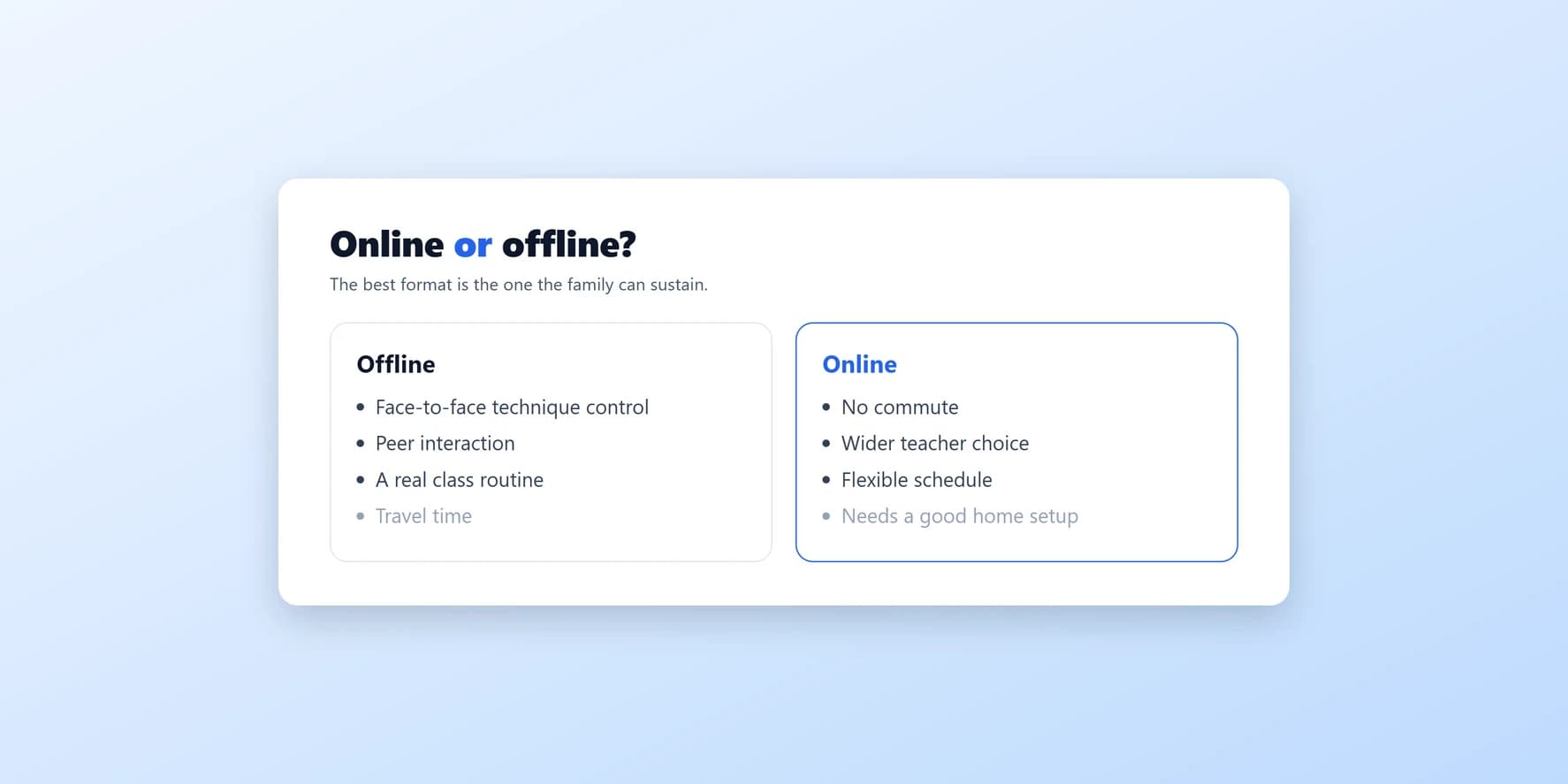
Neither online nor offline mental arithmetic is universally better. Offline classes offer a stronger physical and social learning environment, while online lessons provide greater flexibility, access to teachers beyond the local area and significantly less travel time. The best choice depends on the child, the teacher and whether the family can sustain the format consistently.
Offline
Face-to-face technique control · physical learning environment · peer interaction · strong social routine · requires travel
Online
No commute · wider teacher choice · flexible schedule · easy digital integration · requires good home setup and concentration
The right choice depends on the child and the family.
Offline learning has a natural advantage at the beginning
At the earliest stage of mental arithmetic, correct physical technique matters greatly. The child is learning:
- how to position the hands;
- how to use the thumb and index finger;
- how to move beads efficiently;
- how to avoid unnecessary movements;
- how to perform Simple, Small Friends, Big Friends and transitions.
When the teacher is sitting nearby, small technical errors are easier to notice. The teacher can look at the hands from different angles, demonstrate a movement, correct it immediately and ask the child to repeat it.
For very young beginners, this is a real advantage of face-to-face teaching.
Offline classes also feel like a real event
This is another advantage that is easy to underestimate. The child does not simply open a laptop. They need to get ready, leave home, travel to the centre, enter the classroom, sit with other children and switch into learning mode.
Psychologically, this creates a clear boundary:
“Now I am going to my class.”
For many children, that ritual itself improves focus. Home is associated with many things: toys, food, family, phones, rest. A learning centre is associated with the lesson. That difference can matter.
The physical environment helps some children concentrate
For a child who is easily distracted at home, offline learning can be much easier. There are fewer opportunities to walk away, pick up another device, play with something nearby or interrupt the lesson.
The structure of the centre itself helps the child stay in the learning process. This is particularly useful for younger students.
Offline classes also provide natural peer interaction
A child does not only meet the teacher. They also meet other children of a similar age. They talk, laugh, watch each other, compare results, compete, help, wait for their turn and work side by side.
This creates a social environment that is difficult to reproduce completely online. For many children, the group becomes part of the reason they want to return. They are not only going “to mental arithmetic.” They are going “to their class and their group.”
That social routine can support long-term motivation
This is especially important in a program that lasts not weeks, but months or years. A child may lose enthusiasm for repetitive exercises. But they still want to see friends, classmates, their teacher and the familiar learning environment.
This social component can help maintain continuity.
But offline learning has a practical cost: time
And this is where reality matters. An offline lesson may last one hour. But that does not mean it takes one hour from the family. Parents may need to prepare the child, drive to the centre, find parking, wait and drive home.
A one-hour class can easily become a two-hour family commitment. Sometimes even more.
| The real time cost of one offline lesson | |
|---|---|
| Class | 60 min |
| Travel there | 40 min |
| Waiting / parking | 10–20 min |
| Travel back | 40 min |
| Total | Almost 2.5 hours of family time |
Example only. Travel time varies significantly by city and family.
This becomes a major issue in large cities
The nearest good centre may look close on the map. But in a large city, “a few kilometres away” can mean 40 minutes, 50 minutes or even an hour in traffic. And that is only one direction.
So the question becomes not:
“Is offline better?”
but:
“Can the family realistically maintain this schedule every week for one or two years?”
That is a much more important question.
A centre can be close on the map and still be an hour away in city traffic.
A good format that the family cannot sustain is not a good format
Imagine that parents choose an excellent centre. The teacher is strong. The group is good. But every lesson requires one hour there, one hour back, plus waiting time.
After several months, the family starts missing lessons. The parent is tired. The child arrives stressed. Other activities conflict with the schedule. In theory, the format is excellent. In practice, it is becoming unsustainable.
Consistency matters — regular practice across the week depends on a schedule the family can actually keep.
The best learning format is not only the one that works educationally — it is the one the family can sustain consistently.
Online removes the travel problem almost completely
With online learning, the child can prepare the abacus, open the computer, join the lesson, finish and continue with the rest of the day. There is no commute.
For many families, this is not a small convenience. It is the reason the program becomes possible at all.
This is especially valuable for parents with several children
If a family has school, sports, music, other extracurricular activities and more than one child, transport becomes a serious logistical problem.
Online learning can reduce that load dramatically. That can make regular attendance much more realistic.
Online also removes geographical limits
This may be one of its biggest advantages. Offline learning often forces parents to choose from teachers located nearby. Online learning allows them to choose from a much larger pool. The teacher may be in another district, another city, another country.
The family can choose by quality rather than by distance.
This matters even more at advanced levels
Finding a teacher for a beginner is relatively easy. Finding a strong teacher for advanced Anzan, high-speed calculation, multiplication, division, competition preparation or advanced mental techniques can be much harder.
A family may simply have no suitable specialist nearby. Online solves that problem.
Online does not mean the teacher cannot see technique
This is a common misconception. With a properly positioned camera, the teacher can see the physical abacus, the child’s hands and finger movement.
The setup matters. A laptop camera showing only the child’s face is not enough. A better setup may include one camera for communication and another angle for the hands and abacus. Even one well-positioned camera can work if the working area is clearly visible.
Poor online teaching is often an organisation problem
If the hands are outside the camera, the abacus is barely visible, the child is far from the microphone, the parent is constantly answering, or the teacher only shares slides — then the lesson will be weak.
But that does not prove that online mental arithmetic is ineffective. It proves that the lesson has been poorly organised.
A good online lesson is not a video lecture
Mental arithmetic cannot be taught well if the teacher simply talks for an hour. The child needs to:
- move beads;
- answer;
- calculate;
- show technique;
- complete exercises;
- receive corrections;
- switch between formats.
The lesson must remain active. Not “Watch the screen.” But “Work with me.”
Younger children may still find offline easier
For children around five or six, online concentration can be more difficult. They may struggle to sit in front of a screen, follow instructions independently, switch between tasks and keep the workspace organised.
A physical classroom can make the learning situation clearer. But this is not universal.
Some children actually feel more comfortable online
A shy child may find a new centre stressful. New room. New children. New adult. Noise. At home, the child feels safer. They may speak more freely and engage better with the teacher.
So even with younger children, there is no absolute rule. The child matters more than the label “online” or “offline”.
Online groups can still be social
Children can see each other, answer together, participate in quizzes, join short challenges, compare results and compete. A good teacher can create a real group atmosphere online.
But it requires deliberate lesson design. If everyone sits silently with cameras off, the social effect almost disappears.
Offline has the stronger natural social environment
This is one place where offline usually has an advantage. Children are physically together. They interact before the lesson, during breaks, after the lesson. They read body language naturally. They develop small friendships. This is harder to reproduce online.
So for families that value the social part of extracurricular education very highly, offline can be especially attractive. Whether the lessons are group or individual is a separate choice that matters here too.
Online requires more self-regulation
The teacher cannot always see everything outside the camera. The child may look away, open another window, pick up a phone or receive help from a parent.
That means online learning may require more independence. For younger students, a parent may need to help with setup at first.
But the parent should not become the second teacher
This is important. The parent can help with camera positioning, opening the platform, preparing the abacus and solving technical issues.
But once the lesson begins, the teacher should teach. If the parent whispers answers or corrects every movement, the teacher receives a false picture of the child’s skill — one of the reasons parents support best without becoming a second teacher.
Online can make the lesson more transparent to parents
There is also an advantage here. Parents may occasionally see how the teacher communicates, whether the child is actively working and how engaged they are.
In a physical centre, a parent may have almost no idea what happens behind the classroom door. This does not mean parents should monitor every minute. But the learning process can be more visible.
Digital tools can make online learning much stronger than a simple video call
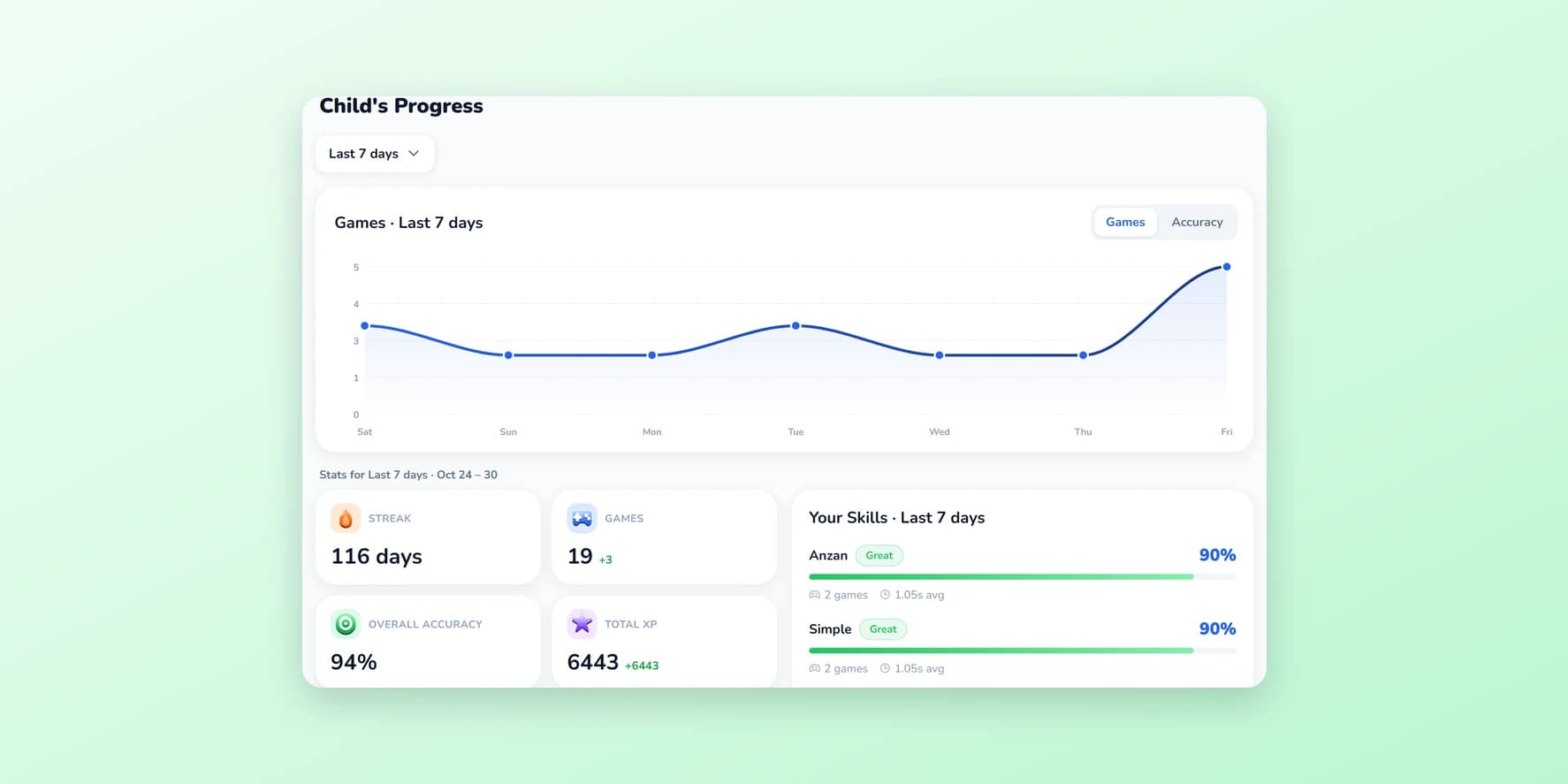
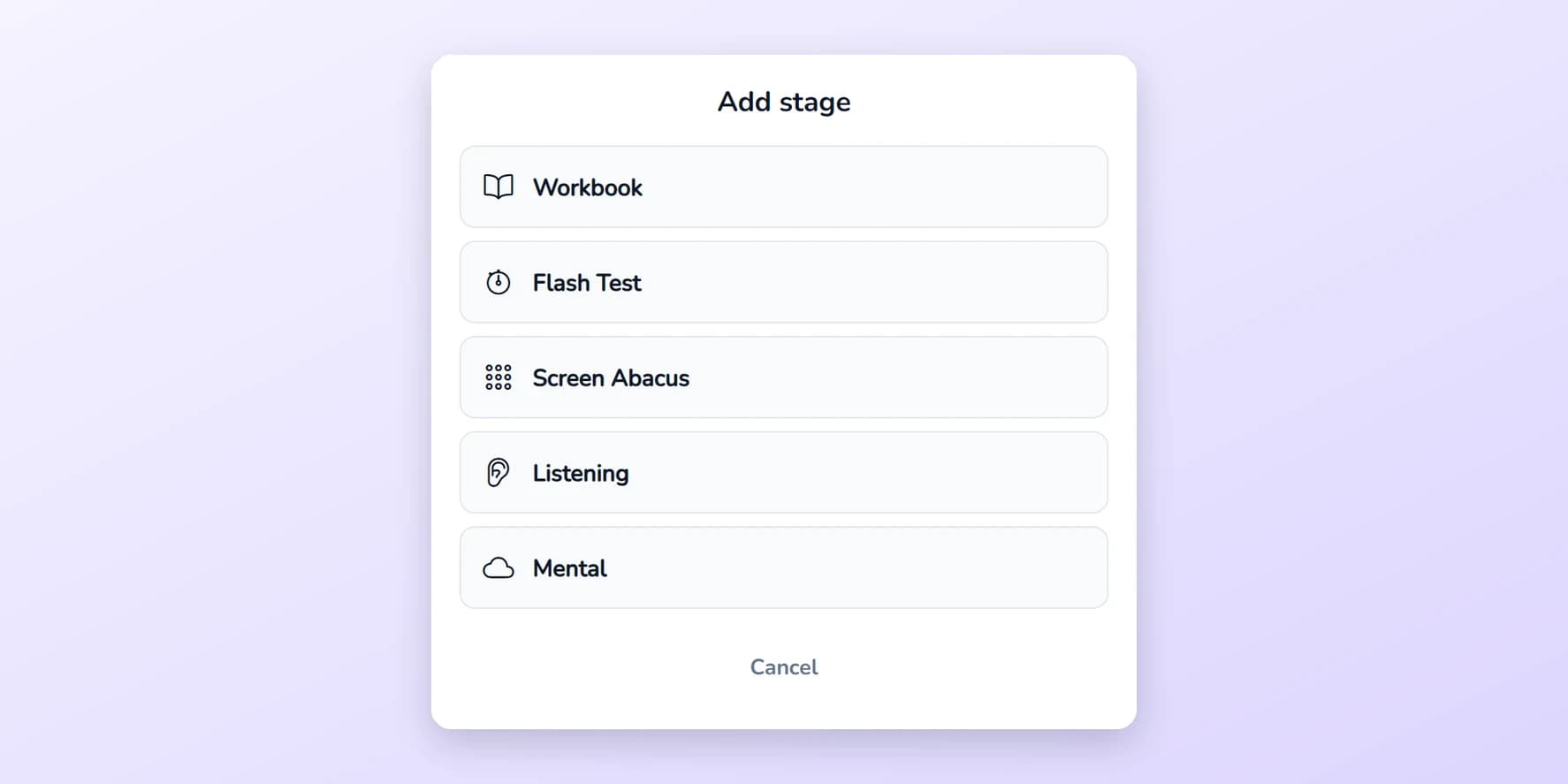
If online teaching consists only of video connection + PDF, its possibilities are limited. A richer environment can include:
Then online teaching is not simply trying to imitate the classroom. It can use digital tools in ways that are difficult to reproduce manually.
Each of these tools trains a different part of the skill — see why mental arithmetic needs more than one type of practice.
Precise speed control is a good example
A teacher may want to check the child at 2 seconds, 1.5 seconds, 1 second. A digital platform can maintain these intervals precisely. The teacher can immediately see where accuracy begins to fall.
That is far harder to reproduce consistently by hand.
But technology does not turn a weak teacher into a strong one
A teacher can have excellent equipment, perfect internet and the best platform. But if they miss technical mistakes, cannot explain rules, do not understand progression and cannot diagnose weak topics, technology does not solve the problem.
It strengthens good methodology. It does not replace it.
A strong teacher can work well both online and offline
The core tasks remain the same. A strong teacher needs to:
- explain clearly;
- build correct technique;
- notice mistakes;
- give appropriate practice;
- monitor progress;
- know when to increase difficulty;
- maintain motivation.
The delivery format changes. The methodological responsibility does not. That is why choosing the teacher usually matters more than choosing the format.
Online versus offline is less important than strong teaching versus weak teaching.
What is better for learning physical abacus technique?
If two equally strong teachers are available and the child is very young, offline may have a small practical advantage at the very beginning. The teacher can observe the hands more naturally.
But good physical-abacus technique can also be taught online. The setup simply needs to support it.
Hybrid learning can combine both
There is no need to choose one format forever. For example:
- first lessons offline, later online;
- main lessons online, occasional face-to-face correction;
- group classes offline, individual support online;
- offline lessons plus digital home practice.
For many families, this is actually the most practical solution.
Hybrid learning reflects how education already works
Modern education is rarely purely online or purely offline. A child may attend a physical class, complete digital homework, join an online competition, use an app for Anzan and review analytics at home.
Is that online? Offline? In reality, it is one learning system using several environments.
- Offline / live teacher
- Physical abacus
- Digital home practice
- Online support when needed
- Analytics
Together — one continuous learning system.
Most practice still happens outside the main lesson
This is another reason the online/offline debate is sometimes exaggerated. Even if the child attends the best physical centre, much of the repetition still happens at home. The teacher is not standing beside the child every day.
So another important question is:
“What happens during the rest of the week?”
One excellent offline lesson followed by six days of no practice will not create the strongest result.
Strong online teaching can be better than average offline teaching
Imagine two options.
Option one
A strong online teacher · good methodology · regular practice · analytics · careful technique monitoring
Option two
The closest physical centre · weak teacher · same workbook for everyone · little feedback
Choosing the second option only because it is offline would make little sense.
And the opposite is equally true
If there is an excellent teacher nearby — small group, good atmosphere, the child enjoys going, technique is carefully controlled — there is no reason to move online simply because online seems more modern.
The format should not become an ideology
Some schools say:
“Online is the future.”
Others say:
“Real education only happens face to face.”
Both positions are too simplistic. The practical question is:
Where does this child learn best — and what can the family sustain consistently?
When offline may be the stronger choice
Offline may be especially attractive when the child:
- is very young;
- struggles to concentrate on a screen;
- needs close physical technique control;
- loves being around other children;
- has access to a strong nearby teacher;
- and the family can comfortably manage the travel.
When online may be the stronger choice
Online may be especially practical when:
- there is no strong teacher nearby;
- the child needs an advanced specialist;
- the family lives in a large city with difficult traffic;
- travel consumes too much time;
- the schedule needs flexibility;
- the child works well at home;
- the program uses digital tools actively.
Cost should be considered too
Online may reduce transport costs, parking, travel time and some facility-related costs. But a strong online teacher is not necessarily cheap. High-quality individual instruction can be expensive in any format.
So: cheaper does not automatically mean better.
Do not compare only the words “online” and “offline”
A low-cost online course with hundreds of students and almost no feedback is one product. A one-to-one online lesson with an excellent teacher is another.
The same is true offline. A class of thirty children is very different from a group of five. So the labels alone tell us almost nothing about quality.
What to look for during an online trial lesson
Do not focus on the teacher’s background image. Look at whether the teacher:
- can see the child’s hands;
- corrects technique;
- asks questions;
- allows the child to work;
- understands mistakes;
- changes the task when necessary.
If the child spends the whole lesson passively watching the teacher, that is a warning sign.
What to look for offline
Almost the same things. Not the furniture. Not the TV on the wall. Not the certificates in reception. Look at:
- how the teacher interacts with the child;
- whether technique is observed;
- whether individual differences are noticed;
- whether feedback is meaningful.
The quality criteria are very similar.
How Amavit fits both formats
Amavit is not designed only for online teaching. It can support traditional classroom lessons, individual lessons, online groups, remote one-to-one teaching and home practice after offline classes.
The purpose is not to decide “online or offline?” The purpose is to strengthen both.
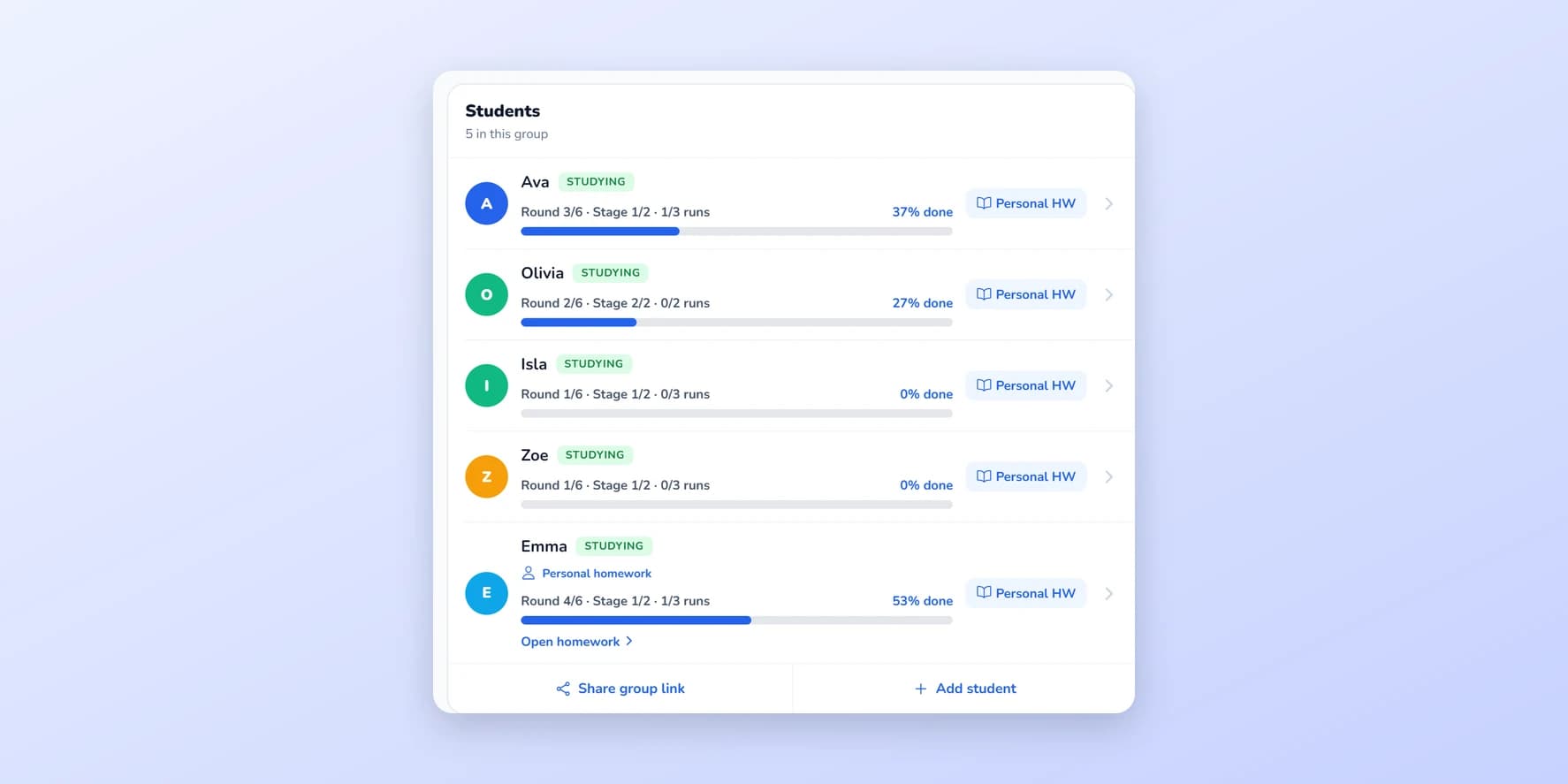
In an offline classroom, the teacher can explain the topic personally, observe physical technique and work with the group. Then Amavit can support practice, homework, speed training, mental exercises and analytics.
In an online lesson, the same platform can support flashcards, an on-screen abacus trainer, screen-based exercises, listening exercises with numbers read aloud, precise speed settings and practice results. Online teaching therefore gains tools that a simple video call cannot provide on its own.
The lesson may happen anywhere. The learning system should stay connected.
The parent can see one continuous learning process
This becomes especially useful in a hybrid model. The child may practise in the centre, at home, with the teacher and independently. But the learning process does not need to feel fragmented. Practice and progress can still be connected.
The main question for parents
So when choosing between online and offline mental arithmetic, do not begin with:
“Which is better in general?”
Ask:
- Who is the teacher?
- Can they see and correct technique?
- Does the child enjoy the format?
- Can the child concentrate?
- Is regular practice realistic?
- How is progress tracked?
- Is the right level of teacher available?
- How much travel time is required?
- Is the cost sustainable?
And perhaps most importantly:
Can the family maintain this format consistently for the long term?
The main conclusion
Both online and offline mental arithmetic can work extremely well.
Offline learning is especially strong in face-to-face interaction, physical technique control, a clear learning environment, peer communication, social routine and the feeling of going to a real class.
Online learning offers access to teachers without geographical limits, much less travel time, flexibility, convenient individual teaching and easy integration with digital practice.
For many families in large cities, travel time alone can completely change the decision. A learning centre may be geographically close but still require an hour of driving in traffic. That matters.
Because the best format is not simply the one that looks strongest in theory. It is the one that the child and family can actually sustain consistently.
A strong online teacher is better than a weak offline teacher. And a strong offline teacher in a good group is better than a poor online program.
For many children, the strongest solution may be a combination:
live teacher + social learning where possible + digital practice + flexibility when distance or time makes regular offline attendance difficult.
Frequently asked questions
Are offline mental arithmetic classes better for beginners?
They can have an advantage at the beginning because the teacher can observe physical abacus technique closely, especially with younger children. But well-organised online teaching can also work effectively.
Can a child learn abacus online?
Yes, provided the teacher can clearly see the child’s hands and abacus and the lesson remains interactive.
What is the biggest advantage of offline mental arithmetic?
The combination of face-to-face technique control, a dedicated learning environment and natural social interaction with other children.
What is the biggest advantage of online mental arithmetic?
It removes geographical and travel limitations, giving families access to a wider choice of teachers and a more flexible schedule.
Is online mental arithmetic suitable for young children?
It can be, but concentration, camera setup and sometimes limited parent assistance with technical preparation become more important.
Can online and offline learning be combined?
Yes. Hybrid models can combine live classes, online support and digital home practice.
Does online learning save time?
Often significantly, especially in large cities where commuting to a learning centre can take as long as or longer than the lesson itself.
Free for teachers